
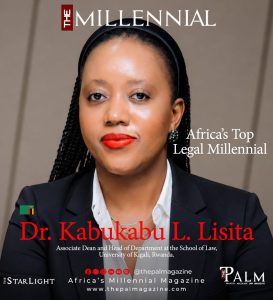
“And perhaps most importantly, protect your integrity. Your reputation will take years to build but can be lost in a moment. Be the lawyer people can trust, not only because you know the law, but because they know you will do the right thing.” – Dr. Kabukabu Laura Lisita
Dr. Kabukabu Laura Lisita is a distinguished human rights expert, legal scholar, and international law academic with specialised expertise in children’s rights, international human rights law, access to justice, and legal education. She serves as Associate Dean and Head of Department at the School of Law, University of Kigali, Rwanda, where she provides strategic academic leadership and contributes to advancing excellence in legal education, research, and professional training.
Dr. Lisita holds a Ph.D. in International Aspects of Law from North-West University, South Africa, and has built an academic and professional career at the intersection of law, human rights, and social justice. Her research and professional interests focus particularly on the protection and promotion of the rights of children and young people, with emphasis on education, child protection, access to justice, human rights advocacy, and legal and policy reform.
As an educator and legal practitioner in the broader justice sector, Dr. Lisita has contributed to the capacity development of judges, prosecutors, lawyers, and other justice sector professionals, strengthening their understanding and application of human rights and international legal standards. She has also participated in and contributed to international human rights initiatives, legal research, policy dialogue, and academic programmes aimed at advancing human dignity, equality, and the rule of law.
Beyond her academic responsibilities, Dr. Lisita is committed to using legal education, research, and institutional partnerships as instruments for social transformation. Her work reflects a particular commitment to ensuring that law responds meaningfully to the lived realities of vulnerable and marginalised communities, especially children and young people. Through her scholarship, teaching, leadership, and advocacy, she continues to contribute to the development of a more inclusive, rights-based, and accessible justice system in Rwanda and beyond.
1. What ignited Dr. Lisita’s passion for the legal profession, and what continues to make the practice of law a deeply fulfilling pursuit for her?
Dr. Lisita’s interest in law began with curiosity. Growing up in Zambia in the 1990s, she was surrounded by social and economic challenges that were difficult to understand as a child. The country was going through a difficult economic period, and the HIV/AIDS epidemic was having a profound impact on families and communities. She remembers seeing the increase of orphaned children, alongside fewer opportunities for some of them to remain in school. Some of these children were her peers, so the issues felt very close to home.
She also witnessed situations where widows and orphaned children were vulnerable to having their property taken by relatives. At the same time, there was a growing number of children living and working on the streets, many of whom were exposed to exploitation. She lacked the legal vocabulary to explain what she was seeing at the time, but she remembers asking herself very simple yet difficult questions: Why does this happen? Who protects people who cannot protect themselves? And can the law actually make a difference?
Looking back, she think those questions were the beginning of her journey into law. They made her curious about justice and about the role that institutions, particularly the law, can play in protecting people who are vulnerable.
When she later studied law in South Africa, that childhood curiosity developed into a much deeper interest in human rights, children’s rights, and international law. She began to understand that law is not just about rules, courts, and legal arguments. At its best, the law is about people. It can protect dignity, challenge inequality, give a voice to those who may otherwise not be heard, and create opportunities for meaningful change.
Dr. Lisita’s journey eventually brought her to Rwanda, where she has continued to pursue that commitment through legal education, research, leadership, and engagement with students, practitioners and policymakers.
What keeps the profession meaningful for her today is the opportunity to make a difference beyond individual cases. As an educator, she has the privilege of shaping the next generation of lawyers. Every time she sees a student develop confidence, think critically about a difficult legal issue, or begin to understand how the law can be used to solve real problems in society, she is reminded of why she chose this path in the first place.
So, in many ways, the questions she asked as a child are still with Dr. Lisita. The difference is that today, she has the knowledge and the platform to do something about them. That, for her, is what makes law such a fulfilling profession.
2. In Dr. Lisita’s opinion, what qualities define a truly exceptional lawyer in today’s world?
Dr. Lisita thinks being an exceptional lawyer today requires much more than simply knowing the law. Of course, strong legal knowledge is important, but it is only the starting point. A good lawyer also needs integrity, curiosity, empathy, adaptability, and a genuine commitment to doing what is right.
The legal profession is changing very quickly. Technology, artificial intelligence, globalisation, and increasingly complex social challenges are changing the way lawyers work and the kinds of problems they are expected to solve. So, she believes a good lawyer must be willing to keep learning. You cannot simply graduate from law school, qualify, and assume that your learning is finished. The best lawyers remain students of the law throughout their careers.
She also thinks empathy is incredibly important. Lawyers deal with people at some of the most difficult moments of their lives, whether they are facing a dispute, going through a family matter, dealing with a criminal charge, or seeking justice after their rights have been violated. Being able to listen carefully and understand the human story behind the legal problem can make a tremendous difference.
At the same time, lawyers need to be critical thinkers and good communicators. You can have an excellent legal argument, but if you cannot explain it clearly or understand the perspective of the person sitting across from you, your effectiveness will be limited.
Ultimately, Dr. Lisita believes the best lawyers understand that law is not just about rules; it is about people. Technical excellence matters, but it becomes much more meaningful when it is combined with ethical leadership, cultural awareness, compassion, and a genuine desire to make a positive contribution to society.
For her, an exceptional lawyer is someone who knows the law, understand people, adapt to change, and still remembers why the law matters in the first place.
3. What is the next groundbreaking project or initiative that Dr. Lisita is or would be working on, and what impact is she hoping it will make?
At the moment, Dr. Lisita’s work sits at the intersection of international law, human rights, technology, and children’s rights. She is particularly interested in understanding how technology can be used to improve access to justice without creating new risks for the people who are already most vulnerable, especially children.
Technology is changing almost every aspect of people’s lives, including how they access information, legal services, and justice. She thinks there is a real opportunity here, but we also need to ask important questions about privacy, equality, accountability, and the protection of children in the digital space. For her, the challenge is finding that balance between embracing innovation and making sure that no one is left behind or exposed to greater harm.
As an academic and a leader in legal education, she is also very interested in bringing people and institutions together. She believes universities should not operate in isolation. There is so much value in creating stronger partnerships between academics, legal practitioners, policymakers, government institutions, and international organisations. When research is connected to the realities that people and institutions are experiencing, it has a much greater chance of influencing meaningful legal and policy reform.
Ultimately, she would like her work to contribute to legal systems that are more inclusive, responsive, and people-centred. The world is changing very quickly, and the law has to be able to respond to those changes while still protecting the fundamental rights and dignity of every person.
For her, the real measure of successful legal scholarship is not simply how many papers one publishes, but whether the ideas can translate into better laws, better policies, and ultimately better lives for people, particularly those whose voices are often the least heard.
4. Which legal minds and books have shaped or are shaping Dr. Lisita’s thoughts and perspectives?
There are quite a few people and books that have influenced the way Dr. Lisita thinks about law, leadership, and society. Two people who stand out for her are Ellen Johnson Sirleaf and Nelson Mandela.
Ellen Johnson Sirleaf’s This Child Will Be Great: Memoir of a Remarkable Life by Africa’s First Woman President particularly resonated with her because of her journey as an African woman navigating difficult political and social circumstances and ultimately becoming Africa’s first democratically elected woman president. Her story speaks to resilience, courage, leadership, and the importance of remaining committed to a vision even when the journey is difficult.
Dr. Lisita has also been deeply influenced by Nelson Mandela’s autobiography, Long Walk to Freedom. What has stayed with her is not only his contribution as a lawyer and political leader, but his extraordinary commitment to justice, equality, and human dignity, even in the face of enormous personal sacrifice.
Dr. Lisita’s thinking has also been shaped by philosophers whose works encourage looking beyond the technical rules of law but asking deeper questions about justice and the human condition. Saint Thomas Aquinas’s Summa Theologica has particularly influenced her thinking about the relationship between law, morality, and justice. Marcus Aurelius’s Meditations has also taught her a great deal about personal responsibility, self-discipline, resilience, and principled leadership -qualities that she believes are just as important in the legal profession as technical expertise.
More recently, Amartya Sen’s Development as Freedom has had a significant influence on her thinking. She finds his work particularly fascinating because it brings together economics, political philosophy, development, and human rights. His idea that development should ultimately be about expanding people’s freedoms and capabilities provides a very practical way of thinking about human rights beyond simply stating what rights people have.
What she finds particularly interesting is that these thinkers come from very different backgrounds, cultures, and periods, yet their work encourages us to ask a similar fundamental question: What is the law ultimately for?
For Dr. Lisita, the answer is simple: law should serve people. It should protect dignity, promote justice, expand opportunity, and provide meaningful protection to those who are most vulnerable.
These books have therefore influenced much more than my academic research. They have shaped the way she teaches, leads, conducts research, and engages with students and colleagues. They constantly remind her that being a lawyer is not just about understanding legal rules; it is also about understanding people, understanding society, and recognising our responsibility to contribute to a more just and humane world.
5. What advice or guiding principles would Dr. Lisita offer young legal professionals and Advocates trying to find their place and purpose in the legal terrain?
Dr. Lisita’s first piece of advice would be: never lose sight of why you chose law in the first place. The legal profession can bring opportunities, recognition, and prestige, but she thinks it is important to let one’s work be driven by purpose rather than prestige. Build a strong foundation through discipline, hard work, continuous learning, and a commitment to doing your best, even when nobody is watching.
Second, stay curious. Law is constantly changing, and the world in which lawyers practice is changing even faster. Your degree is really just the beginning of your learning journey. Read widely, ask questions, do your research, write, and learn from people who know more than you do. Find mentors who are willing to challenge you, not just praise you, and learn to see constructive criticism as an opportunity to grow.
Finally, Dr. Lisita encourages young lawyers to think about the kind of impact they want to make. Professional success is important, but she does not think it should be the only measure of a successful legal career. At some point, one should be able to look back and ask: Whose life did my work make better? What difference did I make?
Use your legal knowledge to advance justice, protect human dignity, strengthen institutions, and give a voice to people who may not always be heard. Whether you become a lawyer in private practice, a judge, an academic, a policymaker, or work in another area of the profession, there is an opportunity to make a meaningful contribution.
And perhaps most importantly, protect your integrity. Your reputation will take years to build but can be lost in a moment. Be the lawyer people can trust, not only because you know the law, but because they know you will do the right thing.
If you approach the profession with integrity, curiosity, compassion, and a spirit of service, Dr. Lisita believes one will find that a career in law can offer much more than professional success. It can give a real sense of purpose and the opportunity to leave a positive mark on the lives of others.
Click here to read our previous millennial, Mohamed Adam Mokrani




















One Response
Dr. Lisita is an exceptional educator whose impact on my legal education at ILPD has been truly transformative. Her ability to break down complex legal concepts with clarity and patience made her lectures both accessible and intellectually stimulating