“In a time when visibility can come quickly, it is important not to confuse attention with growth.” – Desmond Israel
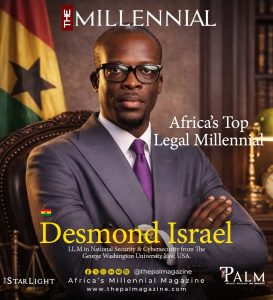
Desmond is a legal-tech strategist, cybersecurity expert, and AI governance advisor with over 20 years of experience in the technology industry and more than half a decade of legal practice. His unique interdisciplinary background makes him a leading figure in digital risk management, regulatory compliance, and executive capacity building across Africa and internationally.
Desmond is a Partner in-charge of Cyberlaw and Technology Practice at AGNOS Legal Company and the Founder/Lead Consultant at Information Security Architects Ltd, a cybersecurity advisory firm and Rapid7 Gold Partner. He serves as Non-Executive Director (Cyber & Privacy Advisory) at Zerone AnalytiQs, British Columbia, Canada.
Desmond is a Lecturer at Ghana Institute of Management and Public Administration (GIMPA) Law School in Ghana, where he teaches courses in law and emerging technologies, digital rights, AI, blockchain and e-commerce law. He is also a Training Consultant with the National Banking College (Ghana), where he designs and delivers board-level capacity-building programmes on IT governance, cyber risk, data governance, and artificial intelligence for directors and executives of financial institutions. His training approach is marked by practical insights, regulatory foresight, and sector-specific expertise.
Desmond’s policy and research work in national cybersecurity, data protection and AI spans collaborations with the Center for AI and Digital Policy (Washington DC), the Internet Security Alliance (Virginia), X-Reality Safety Intelligence (California) and some regulatory bodies. He is a frequent speaker at global conferences on cybersecurity, privacy, and AI policy, and is recognised for bridging legal, technological, and human rights frameworks to guide digital transformation responsibly.
Desmond holds a Master of Laws (LL.M.) in National Security & Cybersecurity from The George Washington University Law School in Washington DC as a GW Law Merit Scholar, and is a Certified Information Systems Security Professional (CISSP), Certified Information Privacy Manager (CIPM), Certified Cybersecurity Technician (CCT), and Certified in Cybersecurity (CC). His advisory expertise includes developing secure enterprise IT frameworks, data protection compliance, cybersecurity risk assessments, and AI regulatory alignment.
Desmond is a Member of the EC-Council Beta Testing Exam Committee and ISC2 Exam Developer, Research and Policy Advisor at Child Online Africa, and Faculty Member at the Trust and Safety Africa Academy. His professional affiliations include (ISC), International Association of Privacy Professionals (IAPP), Ghana Bar Association, ISOC-SIG (Cybersecurity), and the Institute of ICT Professionals Ghana (IIPGH). He is also a Member of the EC-Council’s Beta Testing Committee (USA).
1. The Driving Force for Choosing the Legal Profession
Desmond’s path into law was not a conventional one. He entered law school in 2013 after already spending about eight years building experience in cybersecurity and closely following developments in technology and digital risk. At the time, he was paying attention to where the world was heading and, more importantly, to what was missing in Ghana and across much of Africa. Cyberlaw was not yet a mainstream area of legal practice in the region, even though technology was already reshaping communication, banking, governance, evidence, privacy and national security.
That gap is what drew him in. He did not simply want to become a lawyer in the traditional sense. He wanted to become a lawyer who could bring technical knowledge into legal analysis and help build serious legal thinking around technology, cybersecurity, data protection and digital governance in Africa. He saw early that the region would eventually need professionals who could understand both the systems and the statutes, both the architecture and the accountability.
What continues to make the legal profession deeply fulfilling for him is precisely that point of intersection. For him, law is not just about rules on paper. It is about whether legal systems are strong enough to respond to real-world change. In the Ghanaian and African context, where digital transformation is moving fast but legal and institutional capacity is still catching up, that work becomes even more meaningful. He finds purpose in helping individuals, institutions and society think more clearly about rights, innovation, responsibility and power in a rapidly changing age.
2. Qualities of an Exceptional Lawyer and How Young Professionals Can Cultivate Such Attributes.
In Desmond’s view, the exceptional lawyer of today must be more than knowledgeable in statutes and case law. The lawyer must be adaptive, disciplined, commercially aware, ethically grounded and intellectually alive to the world beyond the law reports. The profession is changing too quickly for anyone to remain effective while thinking narrowly.
He believes one of the defining qualities of a great lawyer is disciplined enthusiasm. That idea resonates strongly with him, particularly through the line, “Discipline is not the enemy of enthusiasm.” He sees that as a serious principle for professional life. Passion matters, ambition matters, vision matters, but without discipline, they rarely amount to excellence. That lesson has stayed with him throughout his journey.
Another principle that has shaped him is the motto from his elementary school: “No lasting glory is won without struggle.” He considers that idea deeply relevant, not only to legal practice, but to any serious pursuit. In his view, excellence is never accidental. It is built through consistency, sacrifice, correction, long hours, and the humility to keep improving. That is especially important for young lawyers, many of whom are entering a profession that now demands far more than advocacy in the traditional sense.
For young professionals in Ghana and across Africa, he would say the first task is to build real substance. They must read widely, write clearly, think carefully and take mentorship seriously. They should not rush to be seen before they have taken time to become. They should also understand the direction of the continent and the profession: digital identity, AI, financial technology, cybercrime, data governance, platform regulation and cross-border compliance are no longer fringe issues. The young lawyer who can combine legal depth with relevance to emerging realities will be far better positioned than one who relies only on old formulas.
3. Significant Ongoing Project or Initiatives and Possible Impacts.
At this stage of his journey, Desmond is focused on helping to build a serious cyberlaw and technology practice within AGNOS Legal Company, where he joined as a Partner barely a year ago. One of his major aspirations is to help move the firm from a more conventional model of practice into a technology-driven law firm capable of offering profound and future-facing legal services within the law and technology space.
That aspiration is not merely about branding or modernising for appearance’s sake. It is about building institutional capacity for the kind of legal problems that are increasingly defining the future: cybersecurity governance, data protection, AI regulation, digital evidence, fintech compliance, platform accountability, cyber risk advisory, emerging technology contracting and public policy support. He sees a real need for law firms in Ghana and across Africa to evolve in a way that matches the complexity of the societies and markets they now serve.
The impact he hopes to make is both professional and systemic. Professionally, he wants to help build a firm that clients can trust for sophisticated work at the intersection of law, technology and governance. At a broader level, he wants to contribute to a shift in African legal practice itself, one where lawyers are not merely reacting to technological change after the fact, but are actively shaping how the law responds to it. In his view, Africa needs legal institutions and professionals who can engage the future with competence, not hesitation.
4. Role Models and Impactful Books
Desmond has long been drawn to legal minds and professionals who understand that law does not operate in isolation from society, power, technology and public purpose. He respects thinkers and practitioners who bring rigour to doctrine but also appreciate that the legal profession must stay responsive to the realities of its time. In the African context especially, he values legal minds who are able to think beyond inherited frameworks and engage the continent’s problems with seriousness, originality and practical courage.
He is not especially drawn to legal romanticism. He is drawn to clarity, structure, strategic thinking and usefulness. That is one reason his all-time favourite book remains The Art of War by Sun Tzu. He has read different versions of it over the years, and he continues to find its lessons relevant not just to business or competition, but to life, leadership, family, planning and professional growth. He sees the book less as a manual for conflict and more as a guide to strategy, foresight, discipline and positioning.
That strategic orientation has influenced how he approaches both law and life. He believes one must think ahead, understand terrain, prepare deeply and act with deliberateness. In many ways, that mindset has shaped his path from cybersecurity into law, and it continues to influence how he thinks about legal practice, institutional growth and personal excellence.
5. Advice or Guiding Principles for Young Legal Professionals and Advocates Trying to Find their Place and Purpose in the Legal Terrain.
Desmond would tell young legal professionals that there is no substitute for discipline, patience and substance. In a time when visibility can come quickly, it is important not to confuse attention with growth. He believes the real work of becoming a lawyer happens in the quiet, demanding parts of the journey: reading when no one is watching, refining one’s thinking, accepting correction, learning from failure and steadily building competence.
He would also remind them that the profession is changing, especially in Ghana and across Africa. The legal issues of the future will increasingly involve technology, data, digital systems, transnational risk, regulatory reform and governance questions that do not fit neatly into old silos. Young lawyers must therefore be curious enough to learn beyond their immediate comfort zones. They must understand not only what the law says, but also the industries, technologies and public realities the law is trying to regulate.
At a more personal level, he would encourage them to respect the struggle that comes with growth. His own life philosophy has been shaped by the belief that no lasting glory is won without struggle. He sees that as a grounding principle for any worthwhile journey. The path may be difficult, but difficulty is often part of formation.
Above all, he would advise them to build with intention. They should not merely ask where the profession is today; they should ask where it is going, and what kind of lawyer they must become to remain useful in that future. For him, purpose is found not by drifting, but by committing oneself to excellence, discipline and service over time.
Click here to read our previous Millennial, Dr Tebello Matsela
Editorial Team
Silver Obioha
Clinton Nyamongo
Kazeem Afolabi
Dikeledi Matlhagare
Tolulope Olasunkanmi
Sulaimon Badmus
Aya Hamdy
Princess Maake
Vera Enubianozor
Brandon Otieno
Oluwabusayo Awodele
Kyenpiya Wonang
Gift Nwoke
Jessica Odoh
Tracy Karumba
Mary-Jones Ossi
Halimah Oladunni
Mary Linus
Peter Momoh
Jessica Omoruyi