
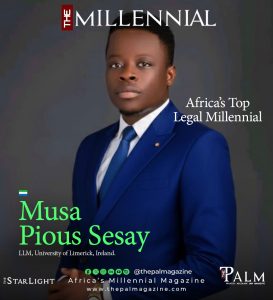
“Young lawyers must also cultivate self-confidence grounded in competence. They should focus intensely on learning and mastering their craft, demonstrating excellence early. In doing so, they will steadily dismantle the biases often associated with youth and inexperience.” – Musa Pious Sesay
Musa Pious Sesay is a Sierra Leonean lawyer, called to the Sierra Leone Bar in November 2018. He graduated with his Bachelor of Law (LL.B) Degree from the Fourah Bay College University of Sierra Leone in 2017. He is a beneficiary of the merit-based Irish fellowship Program -Africa 2023 and a holder of an LLM in Human Rights in Criminal Justice at the University of Limerick in Ireland. Musa is currently a State Counsel at the Office of the Attorney General and Minister of Justice Sierra Leone where he works as a nationally acclaimed prosecutor, since October 2020. His life’s work generally is driven by a strong sense of justice and a burden for, people and nation building, leading him to the path of strong advocacy in youth empowerment and social justice. As a thought leader, he is frequently called upon by the media to share his views on diverse national issues. Musa is the founder of Behind Bars Brighter Futures, an initiative aimed at reducing the justice gap for children and young people who are in conflict with the law. For his contribution to nation building through his work, he was recognised in 2025 as one of the Top 100 Professionals in Sierra Leone by the African Consulting Group Ltd.
1. The Driving Force for Choosing the Legal Profession
Musa commitment to public service and access to justice was not born in a classroom. It was ignited way back when he was a teenager. His mother was a sole trader. She would buy commodities like men’s and women’s clothing, shoes, toiletries, and sell them on credit. She started small and grew her capital bit by bit. She would later travel arduously to neighbouring Guinea by road, bought these products at a more reasonable price, and credit them to customers upon return. It was from that trading she fed, and sent him and his younger sister to primary and secondary school. On many occasions however, he would notice her complaining that many of her debtors were neglecting and refusing to pay her the monies they owed even after using her products.
One particular day, when returning from church, her mother decided to pass by the house of a man whom she had sold a pair of shoes to on credit but neglectied to pay. Instead of the man speaking politely and apologising to his mum, he said something that struck him, and would go on to shape not only his personal life, but his professional interests. With a sense of impunity, he replied to his mum by asking what she would do even if he decided not to ever repay her. He saw an air of helplessness clothing his mother. He saw her trying hard to hold back tears. And he, as a boy around aged 13, felt powerless to offer any solace to his mum.
For days and weeks following, he confronted a troubling question: what happens when rights exist but justice is absent for the most vulnerable? That question has guided his educational choices, professional path, and long-term aspirations in public leadership. He pursued legal education with the conviction that law could serve as a powerful instrument for accountability, social protection, and sustainable development. In pursuit of that ideal, Musa has worked as a lawyer for almost Eight years, including as a public prosecutor, prosecuting crimes ranging from murder, robbery, rape and more, bringing justice and hope to underserved individuals and communities.
2. Qualities of an Exceptional Lawyer and How Young Professionals Can Cultivate Such Attributes.
The legal profession today is undergoing significant transformation, driven by increasing numbers within the profession, rapid digitisation, and the growing influence of artificial intelligence. In this evolving landscape, what distinguishes an exceptional lawyer is not merely technical knowledge, but a combination of competence, integrity, and adaptability.
Competence remains the foundation—mastery of the law, sharp reasoning, and excellence in advocacy. Integrity, however, is what sustains trust, both with clients and within the justice system. Without it, skill alone is not enough. Beyond these, a defining edge for the modern lawyer will lie in the ability to leverage technology intelligently. Lawyers who understand and integrate digital tools into research, case management, and legal strategy will not only enhance efficiency but also expand the frontiers of legal practice.
For young professionals, cultivating these attributes requires deliberate effort: rigorous study, ethical discipline, openness to innovation, and a commitment to continuous learning in a rapidly changing world.
3. Significant Ongoing Project or Initiatives and Possible Impacts
Following his LLM pursuit in Ireland, and building on his focus on youth and criminal law, he has committed himself to addressing one of the most pressing challenges in society: the vulnerability of young people to criminal pathways.
Through his organisation, Behind Bars Brighter Futures Africa, he is working to reduce the justice gap for children and young people in conflict with the law, diverting them from the influences of crime toward pathways of purpose, responsibility, and impact. This work is implemented through policy advocacy, pro bono legal representation, and targeted educational initiatives.
One of the most groundbreaking initiatives his team are advancing is the “YouthCanLead” constitutional reform proposal and campaign to reduce the minimum age requirement for presidential candidacy in Sierra Leone from 40 to 35 years. Their objective is not merely legal reform, but societal transformation. They believe that enabling younger leadership at the highest level of governance will serve as a powerful signal—one that inspires civic engagement, fosters responsibility, and redirects youthful energy away from crime and toward nation-building.
Another is the building of the first legal App in Sierra Leone where indigenes can access and lawyers can sign up for pro bono work, including free explanation of rights.
4. Role Models and Impactful Books
During his undergraduate studies, Musa was profoundly influenced by the works of Lord Denning. His judicial activism, particularly his willingness to depart from convention through bold and, at times, solitary dissenting opinions, left a lasting impression on him. Many of those dissenting views, initially resisted, later evolved into accepted legal principles. From him, he learned the importance of intellectual courage—the willingness to challenge orthodoxy in pursuit of justice.
In terms of literature, several works have shaped his thinking. The The Bible has been foundational, influencing both how he sees himself and lives with others in the world and his approach to work—instilling in him the values of service and love for humanity. The Devil’s Advocate by Ian Morley defined his approach to advocacy at the outset, providing structure and discipline to his art in litigation. Myles Munroe’s The Spirit of Leadership not only taught him that he was created a leader, it helped him understand how to live it, while Beverly E Jones’ ‘Think Like an Entrepreneur, Act Like a CEO reinforced the importance of ownership and leadership mindset, even within institutional roles. Additionally, Napoleon Hill’s Think and Grow Rich expanded his sense of possibility and his personal role in getting what he desires.
5. Advice or Guiding Principles for Young Legal Professionals and Advocates Trying to Find their Place and Purpose in the Legal Terrain.
For many young lawyers, the early stages of the profession can indeed appear daunting. The profession demands discipline, resilience, and clarity of purpose. One of the most critical steps, therefore, is to define what gives their work-life meaning. If their pursuit of law is anchored solely in financial gain, it is unlikely to sustain them through the inevitable challenges of the profession.
A deeper sense of meaning—whether they are criminal defense lawyers, human rights or commercial lawyers, or in public service—provides the clarity and endurance required to navigate the field. In his own journey, a strong sense of justice and a commitment to human dignity naturally led him toward criminal justice reform and public interest advocacy. Young lawyers must also cultivate self-confidence grounded in competence. They should focus intensely on learning and mastering their craft, demonstrating excellence early. In doing so, they will steadily dismantle the biases often associated with youth and inexperience.
Finally, patience is indispensable. The law is a profession of time—time to learn, to grow, to build credibility, and to make impact. Those who remain disciplined, principled, and purpose-driven will not only find their place but will ultimately shape the legal landscape itself.
Click here to read our previous Millennial, Albert M. Agyepong
Editorial Team
Silver Obioha
Clinton Nyamongo
Kazeem Afolabi
Dikeledi Matlhagare
Tolulope Olasunkanmi
Sulaimon Badmus
Aya Hamdy
Princess Maake
Vera Enubianozor
Brandon Otieno
Oluwabusayo Awodele
Kyenpiya Wonang
Gift Nwoke
Jessica Odoh
Tracy Karumba
Mary-Jones Ossi
Halimah Oladunni
Mary Linus
Peter Momoh
Jessica Omoruyi
















One Response
Musa Pious Sesay is a brilliant and remarkable lawyer in Sierra Leone. From his school days, he has been an exceptional student and a star pupil so it comes as no surprise to see him making waves in the legal field. Sierra Leone is truly blessed to have him.