“At its core, the legal profession is about assisting the courts in interpreting the law so that justice is not just delivered in form but in substance.“- Esaya Daniel Abanda Tezo
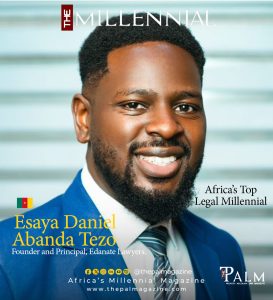
Esaya Daniel Abanda Tezo is a Cameroonian lawyer, entrepreneur, and thought leader whose work straddles the worlds of business, finance, technology, and the creative industries. He is the Founder and Principal of Edanate Lawyers, a forward-thinking law firm based in Yaoundé, Cameroon, dedicated to providing innovative legal solutions for clients across diverse sectors. Since its founding on 14th February 2022, Edanate Lawyers has steadily built a reputation for blending legal precision with entrepreneurial insight, a reflection of its Founder’s unique career path.
Daniel earned his Law degree from the University of Yaoundé II (Soa) in 2014. In 2015, he began an LL.M programme, which he paused after gaining admission to the Nigerian Law School. Thereafter, he deepened his practical grounding in the legal profession, qualifying as a Barrister and Solicitor of the Supreme Court of Nigeria in July 2017. The following year, he was admitted to the Cameroonian Bar on 21st November 2018, at the Court of Appeal of the Centre Region, officially becoming licensed to practice law in both Nigeria and Cameroon.
Before founding Edanate Lawyers, Daniel trained and worked at Kisob Law Office under the mentorship of Barrister Luke Mirac Kisob from 2018 to 2021. Today, Daniel’s practice and influence extend beyond traditional legal services. He is actively engaged in legal education, mentorship, and thought leadership, with a particular focus on empowering Africa’s creative economy. He has been invited to deliver lectures, masterclasses, and courses on legal aspects of fashion, music, film, and technology, helping creators and entrepreneurs better understand intellectual property, contracts, and business structuring. He also spearheads initiatives such as the Media, Entertainment, and Tech Lawyers Association of Cameroon (METELAC), which seeks to build a professional network of lawyers committed to shaping these fast-growing sectors.
In addition to practice and advocacy, Daniel is a writer. He is currently working on a book that interrogates the relationship between politics, governance, and law in Cameroon, advancing the argument that while politics is not governance, both must operate under the discipline of the rule of law.
1. The Driving Force for Choosing the Legal Profession.
Esaya’s passion for the legal profession was shaped early in life, though the path was not immediately certain. As a young man, he weighed several career options, with law and communication among his strongest interests. The turning point came through family influence: his maternal uncle, the late Christopher Jing, Esq., was the first to take him into a courtroom, sparking a sense of admiration that never left him. That spark grew brighter when he later learned that his older cousin, Paul Jing, Esq., had also embraced the profession, reinforcing his vision of what a legal career could mean. He then saw lawyering as a thing for some kind of “gentlemen”, one of which he would want to belong to.
Yet it was his father’s journey as a businessman that ultimately made the choice clear. Growing up, Daniel often saw his father confronted with legal challenges, and through their many conversations he came to understand how essential the law is in protecting business, advancing opportunities, and resolving conflicts. This realisation transformed law from a career option into a personal conviction.
For Daniel, becoming a lawyer was never just about prestige or profession, it was about answering a calling born of family inspiration and lived experience, and about using the law as a tool for justice, empowerment, and meaningful change.
2. Qualities of an Exceptional Lawyer and How Young Professionals Can Cultivate Such Attributes.
In Daniel’s view, an exceptional lawyer today is defined not only by legal knowledge or courtroom skill, but by a steadfast commitment to ethics and a genuine contribution to social justice. He believes that lawyering must go beyond serving clients’ immediate interests; it must also uphold fairness, integrity, and the dignity of people and communities. To him, every lawyer carries a responsibility to ensure that the law remains a force for good in society.
At the same time, Daniel recognises that the legal profession is evolving rapidly under the pressures of technology, globalisation, and shifting client expectations. For him, the exceptional lawyer is therefore one who is adaptable and able to build sustainable practice, a practice that thrives on innovation, embraces change, and remains resilient without compromising its ethical foundation. In his eyes, true excellence in law today lies in combining these values: principled integrity, social responsibility, and forward-looking adaptability.
3. Significant Ongoing Project or Initiatives and Possible Impacts.
Today, Daniel is channeling his energy into strengthening the intersection of law, business, and the creative economy in Africa. Through his firm, Edanate Lawyers, he is spearheading initiatives designed to empower entrepreneurs, artists, and technology innovators with both legal literacy and access to robust legal frameworks.
Among his flagship projects are the development of training series and handbooks for creatives, tackling critical areas such as intellectual property, contracts, and business structuring. Beyond capacity building, Daniel is also shaping the future of professional collaboration. He is at the forefront of establishing the Media, Entertainment, and Tech Lawyers Association of Cameroon (METELAC), a platform that seeks to connect legal practitioners with the industries driving Cameroon’s cultural and digital transformation. His vision is bold yet practical: on one hand, to ensure Cameroonian innovators are not left vulnerable in the global economy; on the other, to inspire a new generation of lawyers who see themselves not only as litigators but as partners in building industries.
Looking ahead, Daniel hopes to lead the creation of a Center for Mediation and Arbitration dedicated to Cameroon’s media, entertainment, and tech sectors, an initiative that would provide creatives with faster, industry-sensitive dispute resolution. Complementing this, he is laying the groundwork for a corporate social responsibility arm of Edanate Lawyers that will offer career orientation programmes for young law students, exposing them to the diverse opportunities within and beyond traditional practice.
For Daniel, these efforts are about more than professional ambition; they represent a commitment to shaping an ecosystem where law becomes a true enabler of innovation, growth, and justice.
4. Role Models and Impactful Books
Several legal minds have profoundly influenced the journey of Esaya, each leaving a lasting imprint on his growth and professional outlook. His earliest admiration for the law was inspired by relatives who were among the first lawyers he truly knew and respected, Christopher Jing, Esq., Paul Jing, Esq., and Henri Job, Esq. Their example not only brought the profession closer to home but also instilled in him a deep respect for its dignity and responsibility. At the University of Yaoundé II, he was further shaped by the intellectual guidance of distinguished lecturers such as Professor Ephraim Ngwafor and Professor Cosmas Cheka, both of whom nurtured his appreciation for the intersection of legal scholarship and practice.
During his time at the Nigerian Law School, Esaya drew inspiration from the then Director General, Mr. Olanrewaju Onadeko, whose discipline and standards left a mark on his professional ethic. He was equally influenced by Justice Lawal Akapo of the High Court, Ikeja, whose judicial temperament and reasoning he observed closely in 2016. In his early years of practice, his principal at Kisob Law Office, Luke Mirac Kisob, Esq., played a pivotal mentorship role, grounding him in the realities of client service and legal advocacy. In addition, the leadership and professional paths of Clement Fondufe and Lynda Amadagana have, in different ways, broadened his vision of how law can be used as a tool for business growth, leadership, and innovation.
When it comes to books, the one that continues to shape Esaya’s thoughts and perspectives is the Bible. For him, it is more than a spiritual guide—it is a compass for justice, integrity, and service. Its principles remain at the core of his personal philosophy and professional practice, providing moral grounding as he forges a career at the intersection of law, business, and creative economy.
For those just beginning their journey in the legal profession, Esaya acknowledges that the path may seem daunting but insists that it becomes meaningful when guided by clear principles. He emphasises that young lawyers must first cultivate a genuine passion for justice. At its core, the legal profession is about assisting the courts in interpreting the law so that justice is not just delivered in form but in substance, while also standing as true advocates for the rights of individuals. This passion, he cautions, must never be overshadowed by the lure of money. For him, the nobility of the profession lies in service first, and only then in reward.
Equally important, Esaya underscores that ethics and professional conduct are sacrosanct. A lawyer’s reputation is his greatest currency, and once lost, it is difficult to recover. For that reason, he advises young practitioners to carry themselves with integrity, honesty, and respect for both the profession and society. At the same time, he encourages them to see law not only as advocacy but also as entrepreneurship—helping individuals and businesses structure their transactions, avoid legal risks, and improve the overall ease of doing business. This dual approach, he explains, allows lawyers to both serve justice and sustain themselves financially.
Beyond practice, Esaya advises aspiring lawyers to build valuable networks and cultivate genuine professional relationships, since collaboration and mentorship are vital in a demanding profession. He also stresses the importance of being willing to assist upcoming and aspiring lawyers, noting that the strength of the profession lies in shared growth and the passing on of knowledge. Finally, he urges continuous learning: the law is dynamic, and those who remain committed to studying, updating their knowledge, and educating themselves will remain relevant and impactful throughout their careers.
In sum, Esaya’s guiding principles for young professionals are clear: be passionate about justice, uphold ethics without compromise, embrace the entrepreneurial side of law, build networks, support others, and never stop learning. Together, these form the foundation of a purposeful, impactful, and sustainable legal career.
Click here to read our previous Millennial, Derrick Kizito Kunyiga
Editorial Team
Silver Obioha
Clinton Nyamongo
Kazeem Afolabi
Dikeledi Matlhagare
Tolulope Olasunkanmi
Sulaimon Badmus
Aya Hamdy
Princess Maake
Jemilat Akerele
Vera Enubianozor
Brandon Otieno
Oluwabusayo Awodele
Kyenpiya Wonang
Gift Nwoke
Jessica Odoh
Tracy Karumba
Mary-Jones Ossi
Halimah Oladunni
Mary Linus
Peter Momoh
Jessica Omoruyi