
“…be ambitious without apology. The continent does not need timid lawyers; it needs lawyers who are prepared to take on hard institutional questions and to spend years rather than weeks on them.”- Samuel Frank Matinou
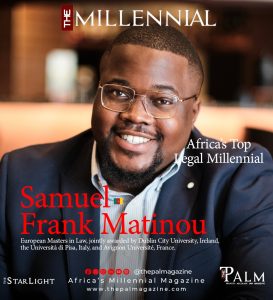
Samuel Frank Matinou is a Cameroonian Lawyer with a Master’s degree in European Law, Data and Artificial Intelligence, jointly awarded by Dublin City University in Ireland, the Università di Pisa in Italy, and Avignon Université in France. He also holds a Postgraduate Diploma in Legal Practice from the Institute of Legal Practice and Development in Kigali, and a Bachelor of Laws (LL.B.) from the University of Kigali, Rwanda.
Samuel currently serves as Policy and Research Officer at AI Skills and Compute Africa (AISCA), a flagship continental initiative founded by Cassava Technologies and dedicated to expanding Africa’s sovereign AI capacity through coordinated investments in talent, compute infrastructure, and policy. He has served as Programme Coordinator for Research and Policy Development at the Center for Law and Innovation (CLI), where he led the strategic orchestration of five specialised research labs; spanning Climate Justice, Tech and Innovation, Human Rights and Gender, Alternative Dispute Resolution, and Trade and Investment. Under his stewardship, the Center convened the African Law and Tech Summit, drawing stakeholders from over fifteen African Union member states, and co-hosted the landmark Africa AI Stakeholder Meeting in Kigali alongside Microsoft and Meta, gathering more than 200 decision-makers to chart the continent’s AI future.
As Editor-in-Chief of multiple special issues of the CLI Journal, Samuel has shepherded scholarship that bridges the worlds of policy, jurisprudence, and emerging technology. He is a contributing author to the seminal Report on the State of AI Governance in Africa (2024 & 2025) and co-author of “Beyond Borders: Exploring Data Embassies as a Strategy for Digital Sovereignty in Africa” published in collaboration with Carnegie Mellon University Africa.
Samuel is an active member of the Berkman Klein Network of Centers at Harvard University, the African Law & Tech Network, and the DPO Africa Network, and serves on University of Kigali Law School Association’s Board of Advisors. He has trained advocates and professionals in AI ethics and governance, and provided pro bono counsel to over ten African startups through an initiative called the Startup Bluebook program. His intellectual compass is fixed on Africa–EU digital partnerships, AI governance, and data embassies animated by a long-standing conviction that the next chapter of digital transformation must be inclusive, equitable, and authored from the Global South as much as for it.
1. The Driving Force for Choosing the Legal Profession.
Interestingly, the spark for Samuel did not come from inside a courtroom or a law library, but from the recording studios and rehearsal rooms of Yaoundé, Cameroon. Growing up as a young musician and bass player, he was fully engaged in the creative process of artists, and it was there that he first encountered law in its most concrete and human form, through its absence. He watched talented musicians, songwriters, and producers see the products of their intellect routinely appropriated by intermediaries who understood the system better than they did. Despite the existence of a legal framework designed to protect intellectual property, the gap between the law on paper and the law in practice was striking, and the consequences for creators were awful. That early observation planted a question he has never stopped asking: how does one ensure that legal protection is not merely declared, but actually delivered to those who need it most?
That question quickly outgrew the music industry. He came of age in an environment where injustice had become almost ordinary, where economic privilege, often illegally acquired, conferred a kind of de facto first-class citizenship, and where those without the means to push back were systematically marginalised. By the time he completed his Advanced Level education, he was certain that he wanted to spend his career making justice visible and enforceable. His initial instinct was political science, but his father, who knew his argumentative temperament well, gently steered him towards law.
What makes the practice of law deeply fulfilling for Samuel is the continuity that runs through his work. As a lawyer trained at the intersection of criminal law, international law, data and AI governance, he believes he has a prima facie responsibility, and a rare opportunity, to help shape the legal architecture that will determine whether technology in the coming decades amplifies justice or entrenches new forms of inequality. That is the work he wants to do, and that is why, every single day, he remains convinced he chose the right profession.
2. Qualities of an Exceptional Lawyer and How Young Professionals Can Cultivate Such Attributes.
The truly exceptional lawyer of this generation, in Samuel’s view, is the one who recognises that we are living through what may fairly be called a fourth revolution—a transformation as consequential as the printing press, the steam engine, and the personal computer combined. Artificial intelligence systems are no longer experimental novelties; they are now embedded in the day-to-day operation of banks, hospitals, courts, schools, and governments. The contracts we draft, the harms we redress, the rights we protect, and the crimes we prosecute are increasingly mediated by code, by data, and by compute infrastructure that very few lawyers have ever been trained to interrogate. To be exceptional today is to be conversant in this new substrate, not as a curiosity, but as a professional duty.
For African lawyers, the stakes of this conversation are uniquely high. The continent is at a pivotal moment: it is simultaneously the fastest-urbanising, fastest-digitising, and youngest region in the world by median age, yet it remains structurally under-represented in the rooms where the rules of the digital economy are being written. Samuel believes that this asymmetry will not be corrected by lament but by competence. African lawyers must become, and be seen to be, the most technically literate cohort their generation has produced. They must understand the legal architecture of data protection, the mechanics of algorithmic accountability, the role of intellectual property in protecting indigenous innovation, the implications of cross-border data flows for African digital sovereignty, and the operational disciplines of cybersecurity and information governance.
It is for this reason that Samuel actively encourages younger colleagues across the continent to invest seriously in postgraduate training that bridges law with the technologies that now shape our societies. Programmes that combine law with data science, AI policy, computational regulation, and emerging technology governance, whether at the master’s level or through high-quality structured executive training, are no longer luxury qualifications; they are increasingly the price of relevance.
He also encourages young African lawyers to read across disciplines: to study competition policy alongside cryptography, AI ethics alongside constitutional law, and the political economy of cloud infrastructure alongside the law of obligations.
Above all, Samuel believes that excellence in this era requires a particular kind of intellectual humility: the willingness to admit that the legal profession does not yet have settled answers to many of the questions our societies are now bringing to us, and the discipline to develop those answers responsibly, rigorously, and in conversation with engineers, ethicists, and the communities most affected. The lawyers who will define the next chapter of African legal practice will be those who treat this moment not as a threat to be managed, but as an invitation to build.
3. Significant Ongoing Project or Initiatives and Possible Impacts.
Looking ahead, the work that most occupies Samuel’s mind is the role he is now privileged to play as Policy and Research Officer at the AI Skills and Compute Africa (AISCA). AISCA sits at the intersection of three of the most consequential conversations of our time: how Africa builds the human capital required to participate in the artificial intelligence economy on its own terms; how the continent secures the compute infrastructure necessary to translate that human capital into sovereign capability; and how the legal and policy frameworks that govern this transition are designed in a way that protects African citizens, African data, and African values, rather than importing wholesale the assumptions of jurisdictions whose histories and priorities are not our own.
For Samuel, this work is profoundly personal. He has long believed that the African continent will not be a meaningful participant in the AI revolution if its participation is restricted to consumption. AISCA is one of the few, if not the only organisations on the continent that has chosen to address all four legs of that challenge; skills, compute, data and policy, simultaneously, and to do so in deliberate partnership with African governments, regulators, universities, and civil society. The contribution he hopes to make is to help build, across multiple jurisdictions, the kind of policy and research foundation that allows ministries, regulators, and courts to act with confidence rather than improvisation when the difficult questions arrive, because they will arrive.
Beneath all of this is a philosophical commitment that Samuel does not consider incidental: the conviction that thinking ahead, properly understood, is an exercise in trust. No serious change in a legal system, an institution, or a continent is the work of one person. It is the work of carefully chosen alliances with people whose competence, integrity, and intentions can be relied upon over the long arc of difficult work.
For Samuel, the practice of looking ahead has therefore always been inseparable from the practice of looking carefully at the people alongside whom one chooses to look ahead. The colleagues, mentors, and institutional partners with whom one builds determine what is possible to build at all.
Trust, in this sense, is not a soft virtue. It is the load-bearing structure on which any serious project of reform ultimately depends. The work he hopes to do at AISCA, and the impact he hopes it will make on the continent, rests squarely on that foundation.
4. Role Models and Impactful Books.
Several legal minds have shaped Samuel’s intellectual formation, and four in particular continue to do so.
The first is Mr Michael Butera, today the Chief Technical Advisor to the Minister of Justice of the Republic of Rwanda and a Harvard Law School graduate who has chosen to bring the full benefit of that training back into the service of his country. Michael’s career embodies a quiet conviction Samuel has tried to internalise: that the most rigorous training is most valuable when it is repatriated, and that lecturing in technology law and constitutional law at the University of Kigali while simultaneously shaping national legal policy is not a contradiction but precisely the kind of integrated public service the continent now requires.
The second is Isobel Acquah, Chief Executive Officer of the AI Skills and Compute Africa Foundation. Isobel’s trajectory; a University College London-trained lawyer with more than two decades of cross-border experience across Europe, Asia, the Middle East, and Africa, who has chosen to anchor her latest chapter in Africa’s AI governance future, models for Samuel what it looks like to combine deep transactional sophistication with an unwavering commitment to youth leadership and to building the institutions Africa now needs. Her role in convening African and global stakeholders on questions of AI governance, data sovereignty, and capacity building has been formative in shaping how Samuel thinks about the relationship between policy, infrastructure, and human capital.
The third is Ridwan Oloyede, Director of Policy and External Relations at AISCA and a Fellow of Information Privacy with the International Association of Privacy Professionals, whose research and policy work in data protection and AI governance has, by any reasonable measure, helped shape contemporary African thinking in this field. Ridwan’s contributions to more than twenty-five policies, guidelines, and bills, his sustained writing on cross-border data flows, deceptive design, and the regulatory infrastructure required for responsible AI in Africa, set a standard of intellectual seriousness and policy craftsmanship that Samuel works to live up to in his own research.
The fourth and most influencial is Florida Kabasinga, Founder and Executive Director of Certa Law Chambers and Certa Foundation. As a former Appeals Counsel at the United Nations International Criminal Tribunal for Rwanda (ICTR) and one of the country’s most respected criminal/human rights lawyers, Florida has demonstrated through her own practice that excellence in the courtroom is fully compatible with deep institutional building outside it; through the centres she has founded for justice and advocacy, for law and innovation, and for climate justice. Her decision to mentor a younger generation of African lawyers, Samuel among them, has been one of the most consequential gifts of his professional life.
The book that has most shaped Samuel’s perspective in recent years is Professor Patrick Loch Otieno (P.L.O.) Lumumba’s Africa Arise: Selected Speeches of P.L.O. Lumumba. Professor Lumumba’s insistence that Africa’s challenges admit of African answers, and that the legal profession in particular holds an overwhelming responsibility for the integrity of the continent’s institutions, has been a steady companion in Samuel’s thinking. It is a book he returns to whenever he needs to be reminded that the work is long, the work is necessary, and the work belongs to those who are willing to take it up.
5. Advice or Guiding Principles for Young Legal Professionals and Advocates Trying to Find their Place and Purpose in the Legal Terrain.
The advice Samuel would offer to young legal professionals on the African continent today begins with a simple analytical exercise: ask yourself, with complete honesty, which of the things you are training to do today will still be needed twenty, thirty, even forty years from now. The answer is not always comforting, but it is clarifying. A great deal of conventional legal practice will be transformed, automated, or commoditised over that horizon. What will not become obsolete, in his view, is the lawyer who has positioned herself or himself at the intersection of law and the technologies that are now reshaping how society organises itself.
Samuel’s first principle, then, is that law and technology have already become deeply intertwined and will only become more so. The commission of harm has changed. People injure one another now through code, through data, through algorithmic decisions, through synthetic media, through cross-border infrastructure that no single jurisdiction fully controls. The way societies respond to those harms, the way investigations are conducted, the way evidence is preserved, the way redress is delivered; all of it has changed. But again, what is change? The lawyer who insists on practising as though none of this were true is choosing to be left behind, hence adamant to change. Young African advocates, in particular, must take seriously their obligation to remain useful to societies that are digitising faster than almost anywhere else in the world.
The second principle is to be ambitious without apology. The continent does not need timid lawyers; it needs lawyers who are prepared to take on hard institutional questions and to spend years rather than weeks on them. Ambition, in this context, is not careerism. It is a refusal to let the most consequential conversations about Africa’s future be held without African legal voices in the room.
The third principle is to be boundless. Samuel encourages young lawyers to read widely, to learn languages beyond their own, and to take seriously the fact that the most interesting legal problems of the coming decades will be cross-border, cross-disciplinary, and culturally textured. The lawyer who has read engineering, economics, philosophy, and history alongside the codes and the case law will be the lawyer best equipped to advise governments, courts, and communities navigating genuinely novel terrain.
The fourth principle is to remain open-minded. The African legal profession is in a moment of becoming. Many of the doctrines, institutions, and standards that will define it for the rest of the century are still being written, and they will be written by people who are willing to listen carefully, to revise their views in light of better arguments, and to build with those whose backgrounds and perspectives differ from their own.
Above all, Samuel would tell a young advocate today what he often tells himself: do the work that is in front of you with seriousness, surround yourself with people whose competence and integrity raise your own ceiling, and trust that careful, accumulated, principled effort over time is the only thing that has ever genuinely changed a legal system. The path may seem daunting at the start but it is entirely worth walking.
Click here to read our previous Millennial, Musa Pious Sesay
Editorial Team
Silver Obioha
Clinton Nyamongo
Kazeem Afolabi
Dikeledi Matlhagare
Tolulope Olasunkanmi
Sulaimon Badmus
Aya Hamdy
Princess Maake
Vera Enubianozor
Brandon Otieno
Oluwabusayo Awodele
Kyenpiya Wonang
Gift Nwoke
Jessica Odoh
Tracy Karumba
Mary-Jones Ossi
Halimah Oladunni
Mary Linus
Peter Momoh
Jessica Omoruyi













2 Responses
Congratulations ! great!
An inspiring and thought-provoking piece, Samuel.
What stands out most is your ability to connect law, technology, and public policy into a clear vision for Africa’s future. I particularly appreciated your emphasis that AI governance, data protection, and digital sovereignty are no longer niche subjects but essential areas for the next generation of legal professionals.
Your point that African lawyers must not merely adapt to technological change but actively shape the legal frameworks governing it is both timely and compelling.
Congratulations on this well-deserved recognition. I wish you continued success in advancing legal innovation and strengthening Africa’s voice in global AI governance.